Semicolon Tattoo Meaning: What It Is and Why People Get It
Summary
A semicolon tattoo means your story isn't over. The symbol comes from grammar: an author could have ended the sentence but chose not to. Project Semicolon, founded in 2013, turned it into a worldwide mark of solidarity for mental health survivors, people who've lost someone, and allies. The design is almost always small, often on the wrist. It's one of the few tattoos with a clean, universally understood meaning.
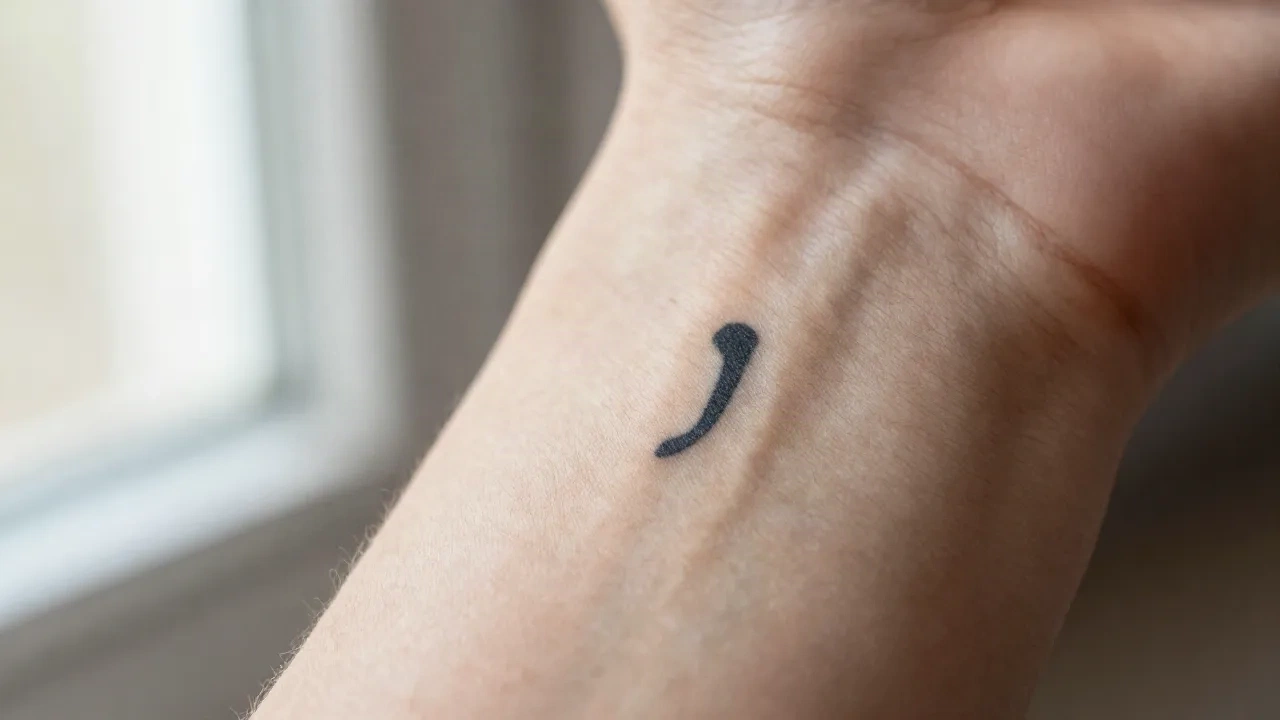
The semicolon tattoo meaning is simple: your story is not over. The punctuation mark comes from grammar -- a semicolon is used when an author could have ended the sentence but chose not to. In the tattoo world, that author is you and the sentence is your life. The symbol became a global marker of mental health solidarity after Project Semicolon launched in 2013. Most people wear it small, on the wrist, and they mean it.
Where the semicolon tattoo came from
Amy Bleuel founded Project Semicolon in 2013 in Wisconsin. She had grown up with depression, struggled through addiction, and lost her father to suicide. She wanted something concrete to mark her own survival, something that could also open a conversation without demanding one.
The semicolon was her choice because it fit the grammar exactly. In a sentence, a semicolon is the point where the story pauses and then continues. She shared a photo of the tattoo on social media, and within weeks it had gone viral. By 2015, Project Semicolon had become a registered nonprofit. The organization estimates it has assisted over 5.2 million people globally -- not through a product, but through the visibility of a small punctuation mark.
Amy Bleuel died by suicide in March 2017 at age 31. That fact doesn't invalidate anything the movement built. If anything, it adds to its honesty. The semicolon never claimed to represent "fixed." It represents choosing to continue, and anyone who wears it knows those are not the same thing.
The symbol carries that weight deliberately. It's not decorative in origin, and that history matters before you walk into a studio.
The three reasons people get a semicolon tattoo
The same small mark carries different weight depending on who's wearing it. Before booking a session, it's worth knowing which of the three categories you fall into, because it changes how the tattoo sits on you in conversation.
Personal survival. The most common reason. You went through something serious -- depression, self-harm, a suicide attempt, a period when the story nearly ended. The tattoo is a marker for yourself. Not a badge to display, but a visible reminder that you made the choice to continue. People who wear it for this reason often describe it as a daily checkpoint.
Tribute. You lost someone. A friend, a parent, a person you knew only through their writing or music. The semicolon is worn partly for them. This version of the tattoo sometimes includes a date or an initial integrated into the design, though not always. It's quieter than a memorial tattoo but more specific than something purely decorative.
Solidarity. You haven't struggled with mental illness yourself, but people you love have. Or you work in mental health. Or you simply want to be visibly approachable for people who might need it. Allies wear the semicolon too, and Project Semicolon included this reading explicitly from the beginning.
None of these reasons is more valid than the others. But they lead to different conversations when someone notices the mark, so it helps to be clear with yourself before you sit down.
What the design variations actually signal
The plain glyph is still the most worn. One small clean semicolon, 1 to 2 centimeters in black or grey, in a legible typeface or hand-drawn. Nothing added. The fact that it says nothing decorative is part of the point -- the symbol works through recognition, not ornament.
That said, there are a few variations that add meaning rather than just visual interest:
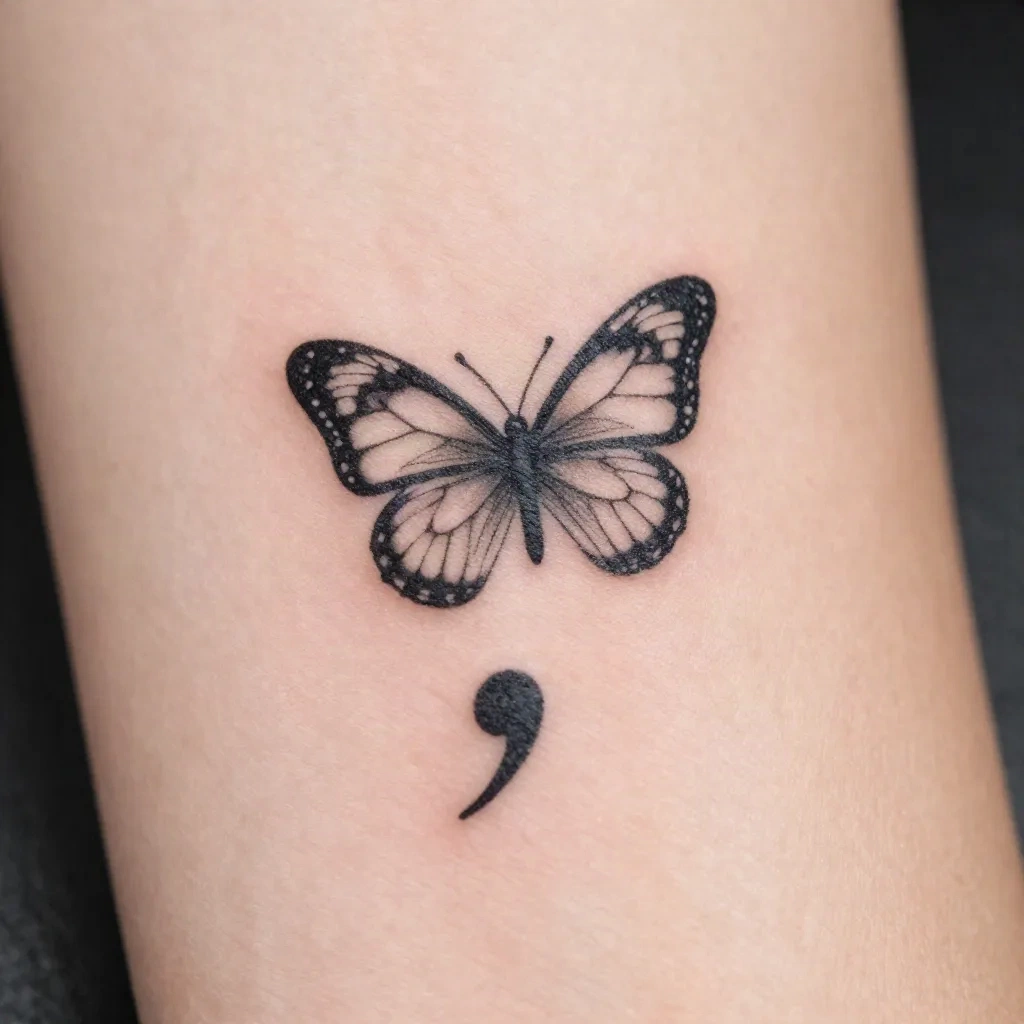
Semicolon plus butterfly. The butterfly adds transformation to the idea of continuation. Still here, and changed. This is the most common variation, and most tattoers carry it in their flash by now. It works well as a fine-line design because both elements read clearly at small sizes.
Semicolon plus heartbeat line. "The pulse goes on." More emphatic than the plain glyph. Popular in nursing and medical communities, and among people who want the mark to read from further away.
Cat semicolon. The dot of the semicolon becomes a sleeping or sitting cat. The visual is softer, the meaning stays intact. This version tends to appeal to people who want the symbol without what some describe as the graphic weight of the original punctuation mark alone.
Integrated word or date. Running the semicolon through a short word -- "still," "continue," "and" -- or placing it alongside a significant date. This works when executed simply. The glyph itself needs to stay legible.
Skip the elaborate backgrounds and the flowers added purely for decoration. The symbol functions because it's small and precise. Scale it up or crowd it with unrelated imagery and you dilute what makes it land.
Where to place it, and why the location matters more than you'd expect
The wrist is the original placement. Amy Bleuel wore hers there, and most photographs from the early movement show wrists. It's visible to you throughout the day, which matters if you're wearing it as a daily reminder. It's also visible to others, which matters if solidarity is part of your reason.
Inside the wrist heals well, holds fine linework reliably, and wears consistently over time. It's the straightforward recommendation for a first tattoo in this location. The inner wrist skin is relatively thin and smooth, which means even a 1-centimeter glyph comes out cleanly in the hands of a competent tattoer.
Behind the ear is the discreet option. Small, intimate, mostly seen when you want it seen. Some people prefer not to explain the symbol to every colleague or casual acquaintance -- behind the ear gives you that choice. The area heals fine but fine lines in that location sometimes fade over a few years and can be harder to touch up than wrist placements.
The ankle sits in the middle: personal, visible in certain contexts, easy to cover when you need to. The inner forearm is better for larger variations -- butterfly designs or heartbeat integrations that need more real estate to read clearly.
One practical detail: the exact position on the wrist changes the visual significantly. On the underside, pointing toward your face when you look at it, it reads as a reminder for you. On the side, visible when your hand is at rest, it reads outward. Worth trying both before you commit to one.
Can the symbol carry weight if you haven't struggled yourself?
This question comes up regularly in forums and consultation rooms. The answer from Project Semicolon has always been yes -- solidarity was designed in from the start, not added as an afterthought.
What matters is that you're not wearing it as an aesthetic choice while being indifferent to what it means. The symbol is simple enough that people who carry their own experience will recognize it and sometimes respond to it. That's worth factoring in before you book. Not as a reason not to get it, but as a reason to be honest with yourself about your reasoning.
If someone sees your semicolon and starts talking about their own experience, what do you say? If you have an answer to that question, you're ready. If the question makes you uncomfortable in a way that isn't about vulnerability but about having nothing genuine to say, it's worth sitting with that longer.
The people who wear this mark tend to notice each other. That recognition -- "I see you, and I'm glad we're both here" -- is the mechanism the symbol runs on. Whether you've struggled personally or you're an ally, you're participating in that.
Before you book: testing the mark in place
A semicolon tattoo looks deceptively simple on a reference image. On your actual body, in the placement you're considering, it reads differently depending on size, orientation, and skin context.
Before the consultation, spend some time with the symbol on your skin. A digital essayage sur photo -- running the glyph on a photograph of your wrist or forearm in the actual position you're considering -- answers questions that reference images can't. Is 1.5 centimeters the right size or does it read too small from a normal viewing distance? Does fine-line work suit your skin tone and texture? Does the butterfly variation you saw online actually look the way you imagined on your specific wrist?
You need a human with a needle to finish the work. That part doesn't change. But arriving at the consultation with clear decisions about placement, size, and orientation means you and your tattoer can focus on execution rather than starting the design conversation from zero.
This is especially worth doing for a mark this specific. Getting it slightly wrong -- wrong size, wrong position, wrong variant -- changes the experience of wearing it every day.
What to say when people ask
Some wearers want to explain. Others don't. Both are valid, and the symbol doesn't obligate you to share more than you want to.
The simplest honest answer, if someone asks: "It's from Project Semicolon. It means continuing when you could have stopped." That covers it. It's accurate. It doesn't require you to say anything about your own history.
If you're wearing it as a tribute, you can say that or leave it unsaid. If you're wearing it as an ally, same. The Project Semicolon website has resources if you want to be able to point someone toward support when a conversation opens up in that direction.
What doesn't serve anyone is claiming the mark means something it doesn't, or wearing it without having thought about what it means to you. Nobody enforces that externally. It's the thing that makes a permanent mark worth getting in the first place.
The design itself takes a skilled tattoer fifteen to twenty minutes. The permanence is the point. Take more time than that before the session to know what you're putting on your body and why. Then let the person with the needle do what they do.