Butterfly Tattoo Meaning: What It Says and What to Skip
Summary
Butterfly tattoo meaning starts with transformation, the caterpillar that becomes something else, and branches into freedom, fragility and remembrance. In ancient Greek one word meant both soul and butterfly, which is why memorial butterflies feel natural. Aztec and Japanese traditions also read butterflies as souls. Color, wing position and placement change the message, and style decides how well it heals. Write your meaning in one sentence, then brief your artist.
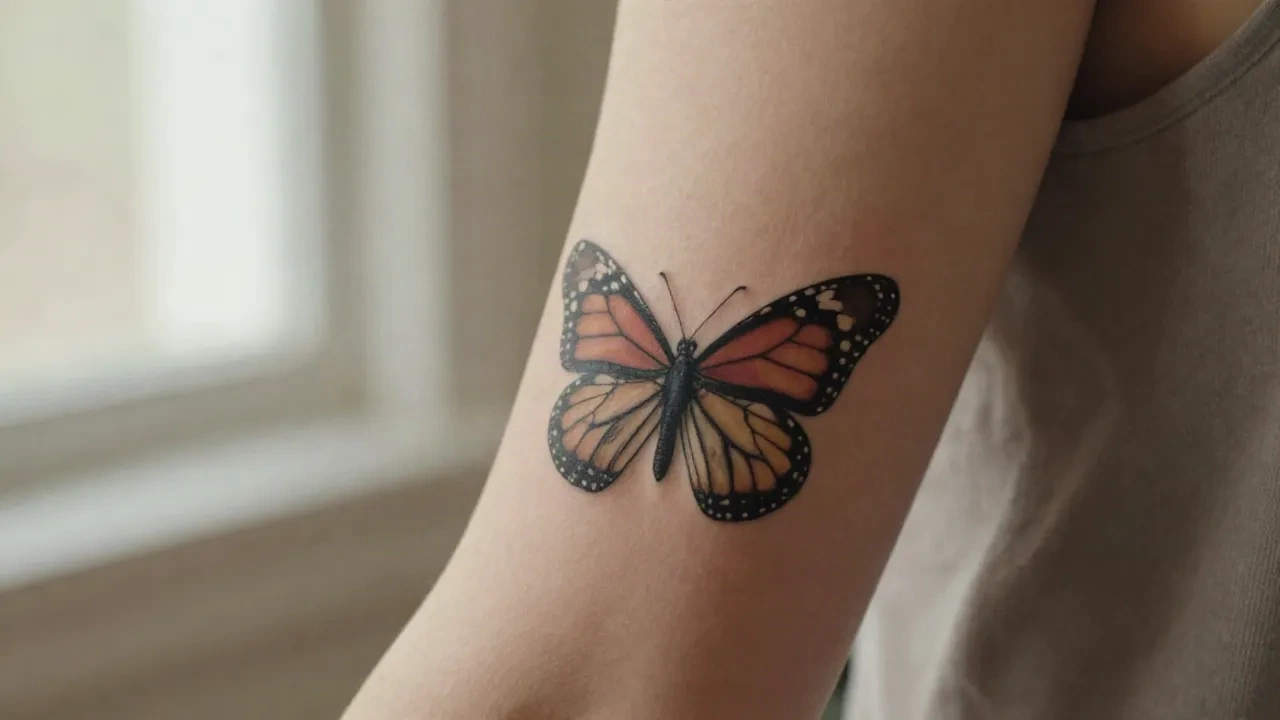
Butterfly tattoo meaning starts with transformation: the caterpillar that dissolves and comes out as something else. Freedom, fragility and remembrance sit right behind. The meaning that counts, though, is the one you can say out loud in one sentence. If you can't, the design isn't ready for your skin.
Here is how the symbol got its weight, what changes with color, count and placement, and where it goes wrong at the studio.
Why does the butterfly keep meaning "transformation"?
Because the biology does the work for you. A caterpillar builds a chrysalis, breaks down almost completely inside it, and reassembles as a winged insect. Nobody has to invent a metaphor.
That is why people book butterflies after a move, a divorce, a recovery, a career flip. The tattoo marks a before and an after. It rarely says "I was a mess and now I'm perfect." It says "that version of me is over."
The second layer is fragility. Wings are thin, lives are short. Plenty of clients want a butterfly precisely because it is not tough, and they like that it asks to be looked at closely.
Where does the soul connection come from?
Older than most people think. In ancient Greek, the word psyche meant soul, life and breath, and it could also mean butterfly or moth. When the Roman writer Apuleius told the story of Psyche and Cupid in the 2nd century, Psyche became the soul in love, tested and finally made immortal. Artists later gave her butterfly wings. The Psyche myth, summarized on Wikipedia is a decent starting point if you want the plot.
So when someone says "my butterfly is for my grandmother," they are, knowingly or not, using a 2,000-year-old shorthand. A butterfly as a soul that has left the body shows up in many cultures. It is the most common reason behind memorial butterflies.
Do cultural meanings change what you should get?
Yes, and this is where a little reading saves a lot of awkwardness. Concrete: the symbol is not neutral everywhere.
Aztec and Nahua imagery. The goddess Itzpapalotl, whose name is usually rendered "obsidian butterfly" or "clawed butterfly," is a fierce skeletal figure with knife-tipped wings, tied to death and to women who died in childbirth. Some accounts also link butterflies to the souls of fallen warriors. If you want an obsidian-winged butterfly in a Mesoamerican style, know that you are borrowing from a death goddess, not a garden insect. The Itzpapalotl entry on Wikipedia lays out the basics.
Japan. Butterflies (chō) were read as souls of the living or the dead. A butterfly drifting into a house could mean someone was about to visit, and a swarm could be an ill omen. A pair of butterflies is also associated with marriage in traditional imagery. Japanese-style tattooing uses the motif, but it is rarely the star of a big piece. Treat the Japanese reading as context, not as a license to copy a back piece.
Christian and Western readings. Resurrection: the tomb as chrysalis. Fine, and widely understood. Nobody will misread it.
None of this is a reason to skip a butterfly. It is a reason to ask where your reference image came from. If your artist cannot tell you the tradition behind a motif you brought in, find another one. Or at least ask.
What do color, number and wing shape add?
Meaning is mostly built from the details, and the details are also where tattoos succeed or fail.
Monarch orange. Reads as migration, endurance, return. Fits a "I came back from somewhere" story.
Blue morpho blue. Rare in nature and visually loud. Clients pick it for calm, hope, distance.
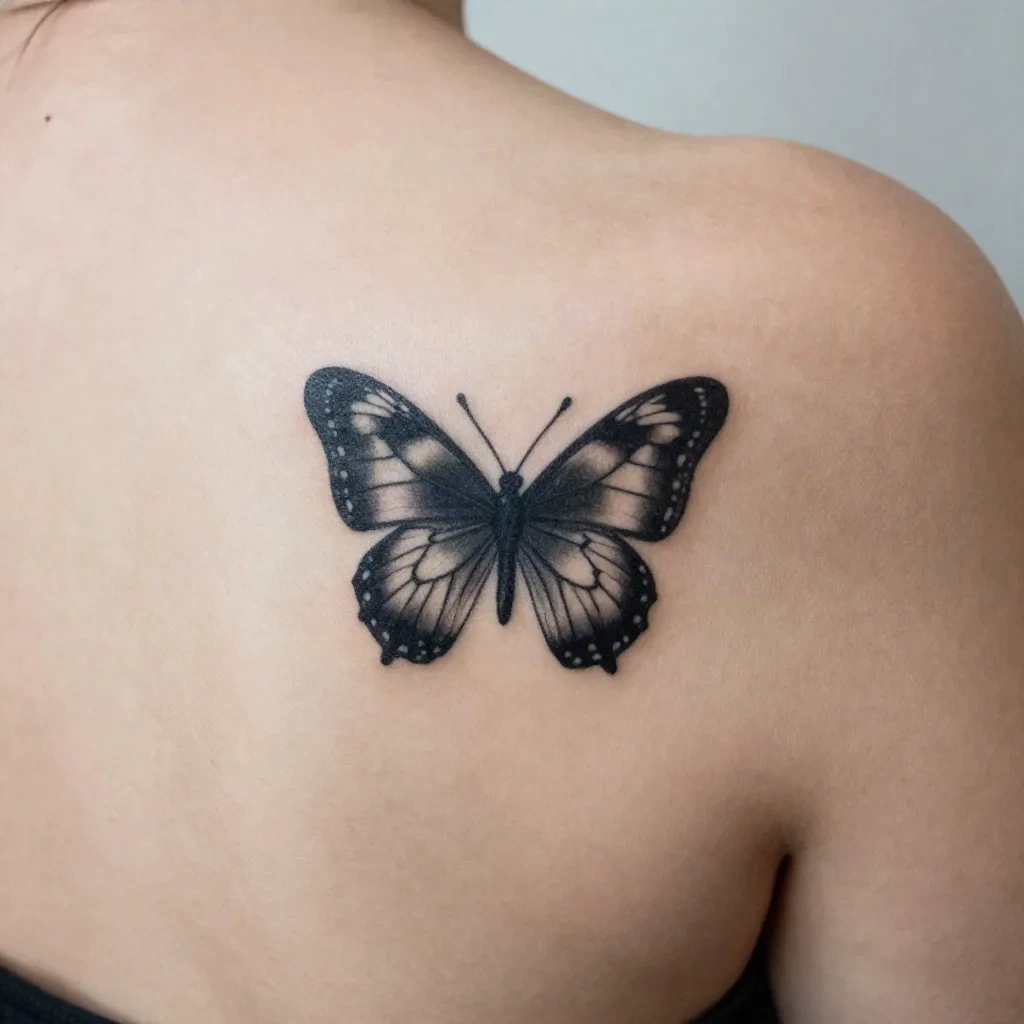
Black only. Nothing to do with mourning by default. Blackwork butterflies are chosen for graphic clarity and for aging well.
White or ghost-pale. Often a memorial. Also the one most likely to disappear, since pale ink on skin fades first.
One butterfly vs a group. One is personal. A cluster reads as celebration, or as a rite of passage shared with others.
Open wings vs closed. Open means arrival, freedom. Closed or resting means waiting, gestation, a pause before the next thing.
Broken or tattered wings. Survival. Damage that stayed in the picture.
A word on skulls and death's-head moths. A moth with a skull pattern on its back is not a butterfly with a dark mood. It is a different animal and a different message, so name it correctly when you book.
Which placement makes sense for which meaning?
Placement is part of the sentence. A butterfly over the sternum says something different from one on the ankle, and healing differs too.
The nape and upper back suit symmetric designs, because the body is symmetric there and the wings sit flat. Ribs and hips ask for larger, flowing pieces and hurt more than most people plan for. Forearms and calves are the easy zone: flat, well supported, easy to photograph and to cover.
Wrists, fingers and the sides of feet are the places where we say "think twice." Thin lines in high-friction areas blur and drop ink. A fine-line butterfly on a finger can look soft after a couple of years, and no amount of lotion fixes that. A butterfly is a small shape with big wing detail, so size is the real constraint: go too small and the veins in the wings close up as the ink spreads.
For shape-hugging placement, the usual trick is to let the wings follow muscle or bone rather than fight them. A butterfly across a collarbone or hugging the hip can look alive. The same butterfly on a flat patch of thigh can look pasted.
Which style fits your butterfly?
Pick the style first and the meaning will follow, because style decides what survives healing.
Fine-line. Delicate, popular and honest only when sized right. Expect fading at the edges within a few years, and plan a touch-up. Choose an artist who shows healed fine-line work, not fresh photos.
Blackwork and dotwork. Strong, graphic, forgiving of time. A dotwork butterfly with shading built from stipple holds up well on arms and shoulders.
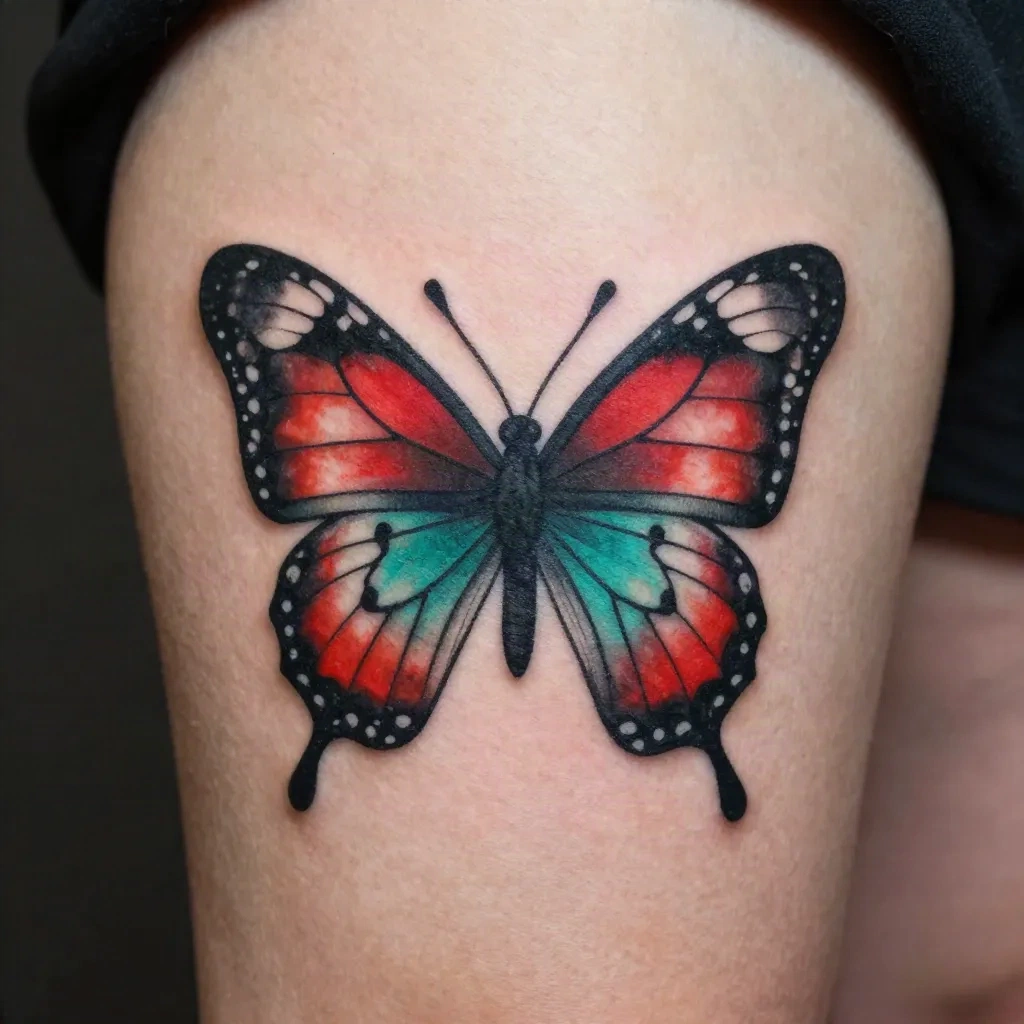
Neo-trad. Thick outlines, saturated color, a bit of drama. Neo-trad butterflies are the ones that still look like butterflies from across a room, which is the whole point of the style.
Watercolor. Looks great in photos on day one. The soft edges and lack of outline are exactly why many of these blur in a few years, so choose an artist who builds a skeleton line under the color.
Realism. A true-to-life monarch or morpho asks for a tattooer with real realism work in the portfolio, healed. Ask to see healed shots, not fresh ones.
Can AI help you design a butterfly, and where does it stop?
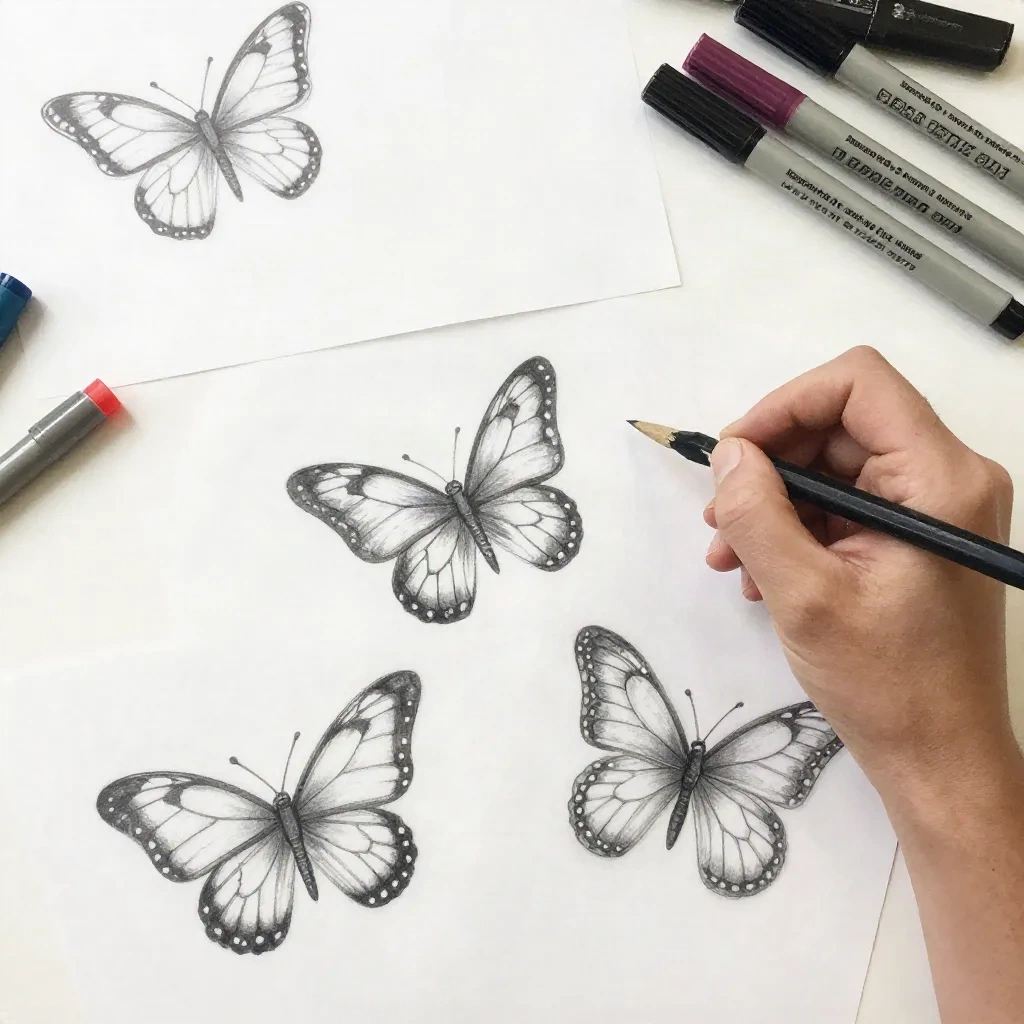
It can save you a bad first session. You describe the idea, get a dozen variants, then try the favorites on a photo of your own arm before anyone touches you with a needle. That's the use case.
Concretely, here are the tools people use for it. They are not equal, and they do different jobs.
inke generates flash variants and runs the essayage on photo in the same flow, which is the combination that matters for a butterfly, since the wing proportion changes with the body part.
InkHunter is the long-running try-on app: you place a design on your skin through the camera. Good for checking size and angle, thinner on generating new ideas.
BlackInk AI leans toward design generation with a body-placement preview. Check the free tier limits before you build a plan around it.
TattoosAI sits in the same family: prompt in, designs out. Useful for brainstorming, less so for fine control.
The limit is simple. A generator will happily give you a butterfly with eight wings or veins that go nowhere. You still need a human with a needle to finish the job: a tattooer redraws the wings so they work at actual skin scale, fixes line weight, and tells you when your idea is too small to hold. Use the output as a brief for your artist, never as a stencil.
How do you brief your artist without getting a clipart butterfly?
Bring three things. A sentence about what the butterfly stands for. Two or three references you like, with a note on what you like in each (the wing shape, the color, the line). And a body part, with a photo.
Then listen. A good tattooer will push back on size, push back on placement, and sometimes push back on the whole idea. That is the job. If your artist cannot show you healed butterflies in the style you want, find another one.
Questions worth asking at the consult:
How will this look healed in five years at this size?
Which wing details should we simplify so they don't close up?
Do you recommend a touch-up window, and is it included?
Where did this motif come from, if it is a cultural reference?
Skip these butterfly mistakes
Skip the butterfly that is too small for its own detail. Skip the tramp-stamp flashback you saw on a celebrity unless you actually want that look; that cliche has a long memory, though it is quietly coming back in a more careful, bigger form. Skip a copy of someone else's piece. Your artist will not do it, and they should not. Skip meaning-by-search-result: three websites repeating each other is not research.
Worth it if you have a real story and an artist who has done this motif before. Worth a pause if you only like the shape. Both are valid, but only one makes you look at the tattoo in ten years and still nod.
What would we actually do?
Write your one-sentence meaning. Pick a style that survives healing. Test the size on your skin with a try-on. Bring the result to a tattooer you trust and let them fix what the screen got wrong. That is a butterfly you will keep.